- Home
- CellFluor GST, Cell-based GST Activity Assay Reagent/DNs-Rh (Cell-based GST Activity Assay Reagent)

CellFluor GST, Cell-based GST Activity Assay Reagent/DNs-Rh (Cell-based GST Activity Assay Reagent)
Product#: FNK-FDV-0030
$418.60
Availability:
Ships in 1-2 Weeks
CellFluor GST, Cell-based GST Activity Assay Reagent / DNs-Rh (Cell-based GST Activity Assay Reagent)
Cat.No. FNK-FDV-0030
Size 0.1 µmol
Storage -20ºC
Shipping (Short Term): Room Temperature
Description
Novel activity assay probe for GSTs in live cells DNs-Rh < Cell-based GST Activity Assay Reagent >

Glutathione S-Transferases (GSTs) are widely conserved in nature from bacteria to plants and animals. In human, over 20 members are identified and classified into three subfamilies. GSTs play an important role in detoxification of endogenous toxic metabolism or xenobiotics through converting them to glutathione (GSH)-conjugates.

As many studies suggested, expression level of GSTs is significantly increased in cancer cells, GSTs are considered as anti-cancer drug-resistant enzymes in malignant cancer cells through the neutralization of drugs. To understand biological functions of GSTs, tools for monitoring GST activity are very important. Although several reagents including CDNB (conventional GSTs probe) for this purpose have been developed, no tool to measure intracellular GST activity was commercially available.
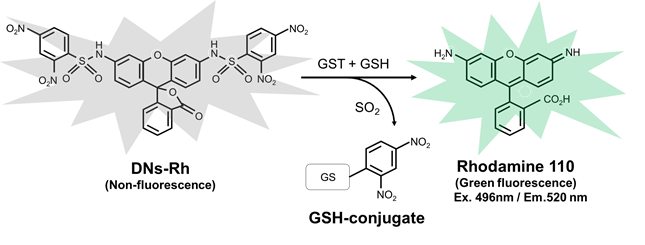
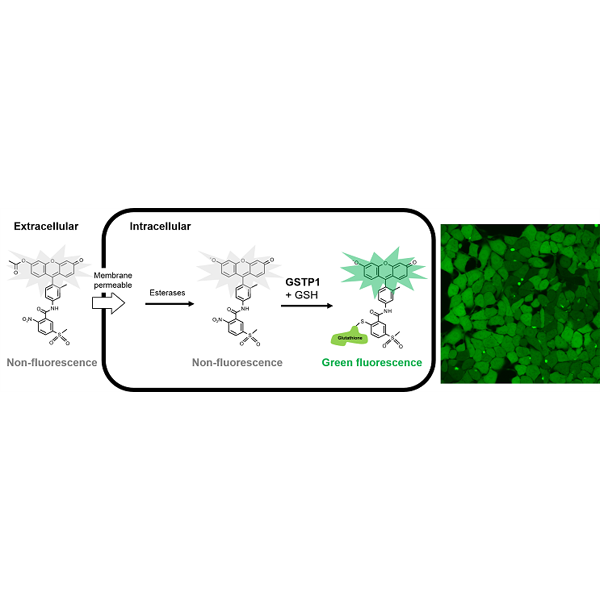
DNs-Rh is a novel fluorogenic substrate of GSTs discovered by Dr. Hiroshi Abe, Nagoya University. DNs-Rh is a rhodamine 110 derivative which protected by DNs (dinitrobenzenesulfonamide). This probe emits very low fluorescence (quantum yield = 0.0007) at normal state. After deprotected by thiols, rhodamine 110 is released and exhibits strong fluorescence (quantum yield = 0.645, S/N ratio ~900). DNs-Rh can be used as a fluorogenic GST activity assay probe. An important advantage of this probe is high cell-permeability and this probe is applied to intracellular GST activity under live cell condition. As DNs group is a well characterized substrate for various types of GST members, DNs-Rh is able to monitor pan-GST activity both in cell and in vitro.
Various applications are available. DNs-Rh is a powerful tool not only to investigate GST activity in live cell upon any biological stimulation, but also to develop GST inhibitors under live cell condition. This product has been commercialized under the license from Nagoya University.
Conventional method vs. DNs-Rh
|
Probe |
|
Conventional method (CDNB) |
DNs-Rh |
|
Measuring Method |
|
UV |
Green Fluorescence |
|
Application |
in vitro |
Possible |
Possible |
|
Live Cell Imaging |
No |
Yes |
|
|
Flow Cytometry |
No |
Yes |
|
|
Sensitivity |
|
Low |
High |
|
Throughput |
|
Low |
High |
|
Speficity |
|
Low |
High |
|
Co-staining |
|
No |
Yes |
Chemical Information
- Formulation :C32H18N6O15S2
- CAS No. : 3829-23-0
- Molecular weight :790.6 g/mol
- Solubility : Soluble in DMSO
- Ex/Em: 496/520 nm (Rhodamine 110)